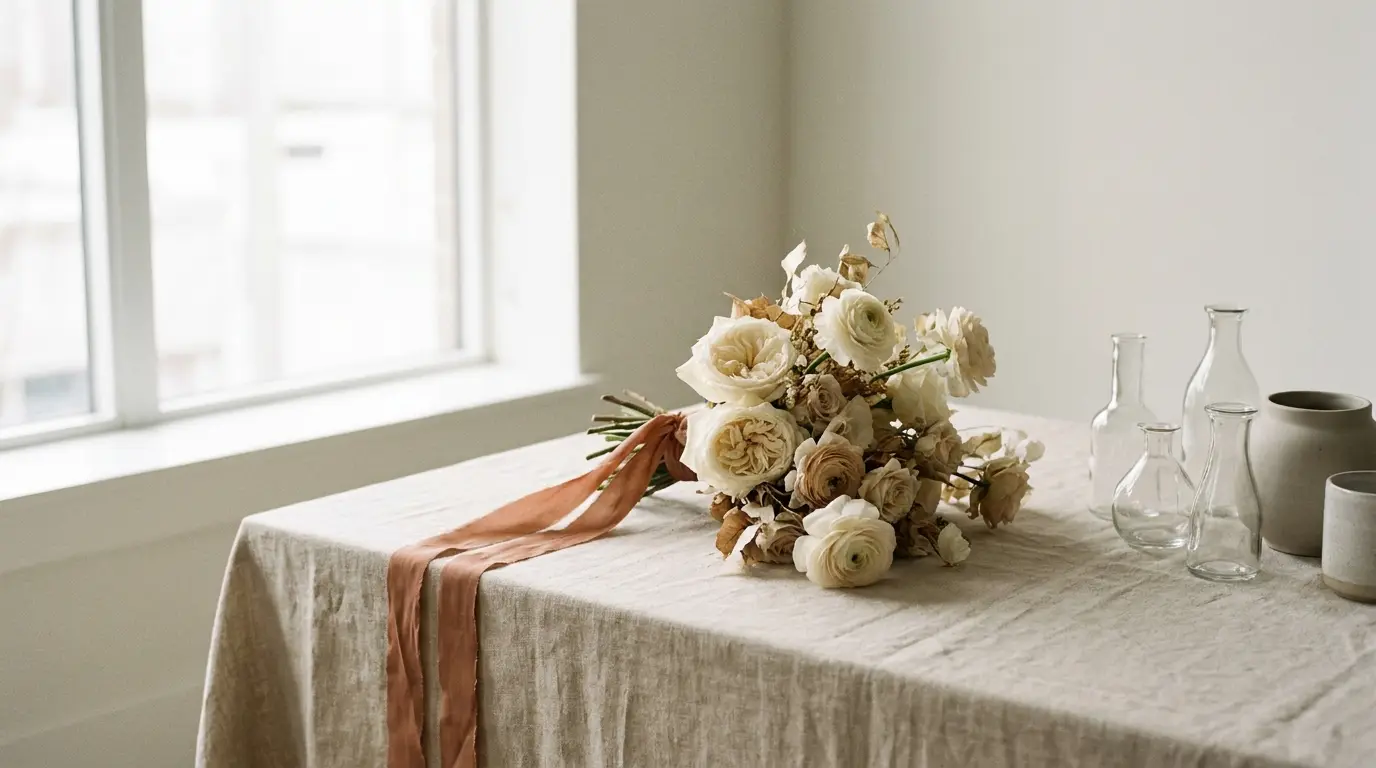
Couples hiring a full-service florist typically spend $2,500 to $3,500 on wedding flowers, 7 to 10% of the total budget. Behind that number sits a price list nobody publishes: what a bouquet costs, what a centerpiece costs, and what the crew that installs and tears it all down costs. A wedding flower budget holds when it is built item by item, because the total is only the sum of counts you control.
What wedding flowers cost, item by item
Florists price a wedding as a list of line items plus labor, and every line is a unit price times a count. The ranges below are typical for a full-service florist in a mid-size American market; large metros run higher.
| Item | Typical range |
|---|---|
| Bridal bouquet | $150 – $350 |
| Attendant bouquet | $60 – $110 each |
| Boutonniere | $15 – $35 each |
| Corsage | $25 – $45 each |
| Low centerpiece | $75 – $250 each |
| Elevated centerpiece | $250 – $500 each |
| Ceremony arch or installation | $500 – $3,000 |
| Aisle arrangements | $20 – $60 per marker |
| Cake flowers | $50 – $150 |
| Labor, delivery and strike | 20 – 40% of the order |
Run a real order through the table and the typical total assembles itself. A wedding with one bridal bouquet, four attendant bouquets, six boutonnieres, two corsages, a modest arch, twelve low centerpieces and cake flowers prices out around $2,700 in stems and arrangements. Add 25% for labor, delivery and strike and the invoice lands near $3,400, inside the typical band before a single premium stem has been chosen.
The composition of that total is the useful part. Personal flowers, the ones in every photo, are around $700 of it. The reception tables are more than half. When the number needs to come down, the tables are where it comes from.
The share of the budget flowers take
At 7 to 10% of total spend, flowers sit in the middle tier of wedding lines, well under venue and catering. Seeing where the floral line sits among the others keeps the number honest in both directions: a $6,000 floral order on an $18,000 wedding is a choice to fund flowers from some other line, not a market rate.
The friction point is the florist minimum. Set the typical percentages against the 2025 median wedding spend of $18,231 and a median-budget couple has $1,300 to $1,800 for flowers, while full-service florists in metro markets commonly set minimums at $2,500 to $4,000. That mismatch, not stem prices, is why flowers feel expensive at median budgets.
Below the minimum, the market still works. A la carte florists deliver bouquets, boutonnieres and loose centerpiece stems without design service or setup. Ordering personal flowers from a florist and dressing tables with bud vases, candles and greenery routinely lands the whole line under $1,500. The trade is labor: someone you know is placing those vases.
What three floral budgets actually buy
At $1,200 to $1,500, the order is a la carte: a bridal bouquet, attendant bouquets, boutonnieres and delivered bud-vase clusters for the tables, with your own people handling placement and no crew on-site. The photos carry the flowers, and the room carries candles.
At $2,500 to $3,500, the full-service band, the order looks like the sample above: personal flowers, a modest ceremony piece, low centerpieces on every table, and a professional crew delivering, installing and striking all of it. This is the version most full-service florists design toward by default.
At $6,000 and up, the money is buying scale and structure: elevated centerpieces, a substantial arch or hanging installation, and the additional crew hours that assembling and removing built pieces require. Roughly a third of a statement budget is labor, which is worth knowing before admiring one.
What moves the number
Stem choice
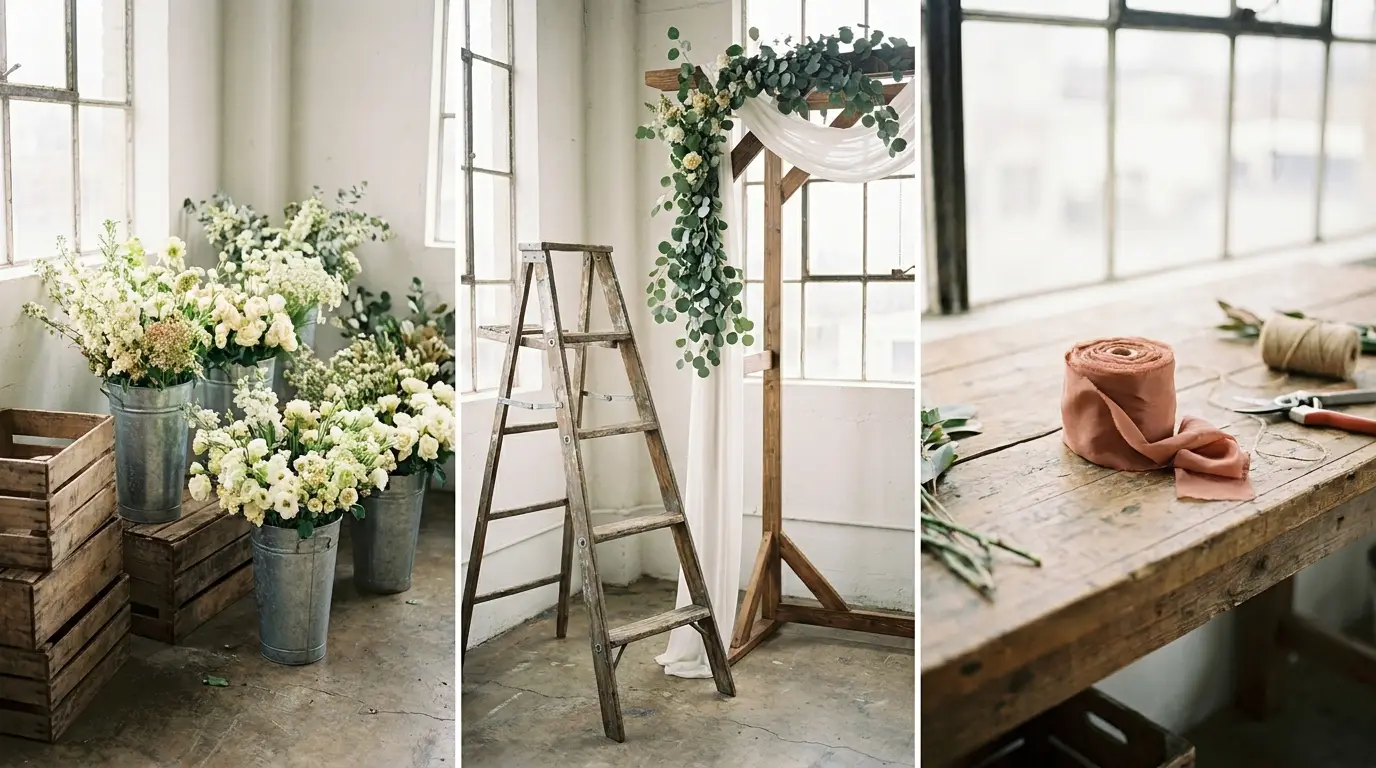
The same bouquet shape can be built at three price points. Peonies, garden roses, ranunculus and orchids sit at the top of the stem market; carnations, alstroemeria, stock and mums fill the same silhouette for a third to a quarter of the cost. A florist asked to hit a number will substitute; a florist handed a photo of peonies will quote peonies. Asking for the recipe, the stem list behind a quoted arrangement, is a normal request, and it is the only way to see which line the substitutions would move.
Season and supply
Most stems in American weddings travel. The US imported nearly $3.3 billion in cut flowers and nursery stock in 2022, with Colombia supplying about 37% of that value and imported fresh-cut roses alone passing $800 million. A supply chain that global answers to demand windows, not to your date: the weeks around Valentine's Day and Mother's Day price roses and mixed stems at their annual peak, and a wedding adjacent to either inherits the markup.
In-season, locally available stems cut the travel out of the price. A florist told the month and the palette, rather than the exact varieties, can buy whatever is best-priced that week, which is the cheapest flexibility a couple can offer.
Labor
A floral invoice pays for hands as much as stems: processing and conditioning flowers for days before the wedding, building arrangements, loading, driving, installing, and returning at night to strike it all. That is why labor, delivery and setup commonly run 20 to 40% of the order, and why halving the stem budget never halves the invoice. The labor does not shrink with the flowers.
The venue itself
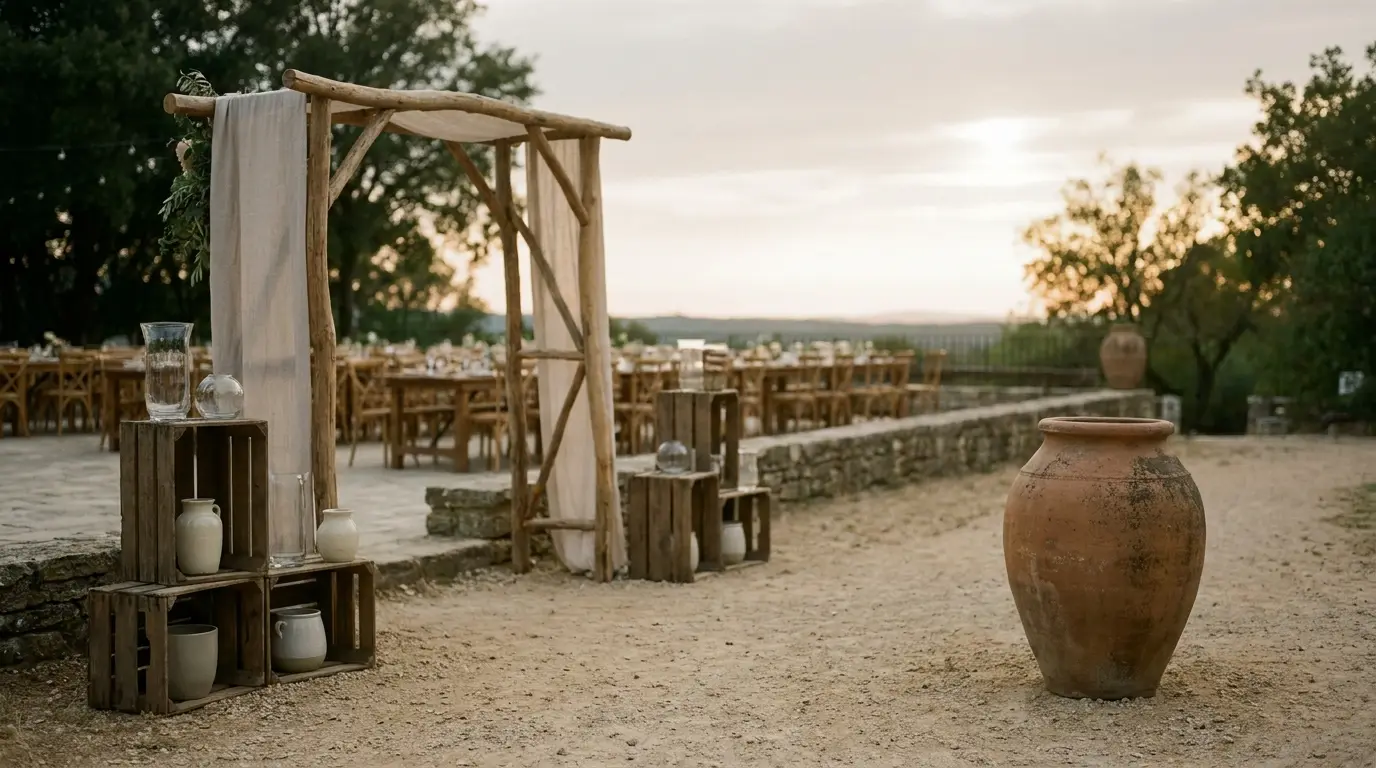
A ballroom with patterned carpet, chandeliers and its own decor needs accent florals. A blank barn or warehouse needs the room itself built: arch, aisle, every table, often hanging pieces. The same guest count can carry a floral order twice the size depending on the room, and Austin venues differ visibly on this between full-dressed historic rooms and blank-slate event spaces.
Where the money hides: installation and strike
Arches, hanging installations and anything built on a ladder are quoted as design pieces, but they are paid for twice: once to build and once to remove. Strike, the teardown after the event, is the half that quotes routinely leave as a line called labor without a number attached.
Venue rules set the strike bill. A venue with a midnight curfew and a same-night clearance rule forces the florist's crew to come back at 11 p.m. and work at night rates. Rented vessels and structures have to go back on the truck, which is why a wedding can owe floral labor hours after the last guest has left.
Logistics price in earlier than couples expect. A venue up two flights with no freight elevator, a ceremony lawn a quarter mile from parking, or a site an hour outside town each add crew time, and crew time is billed. Florists quote these realities after a site question or a walkthrough, which is one more reason the venue decision belongs before the floral one.
- Ask whether strike is included, and at what hour the crew returns.
- Ask what the venue requires removed the same night versus the next morning.
- Ask which vessels are rented and which are yours to keep or give away.
- Ask what an installation costs to remove before approving the sketch.
Trimming the line without it showing
Floral cuts are the least visible cuts in a wedding budget because the room, not the item list, is what guests remember. Repurposing ceremony pieces at the reception, lowering the greenery-to-bloom ratio and concentrating spend in one statement piece are the standard moves, and they belong inside a wider pass at the budget ranked by dollars returned.
The order of operations matters. Cut counts before cutting stems: fewer, larger tables mean fewer centerpieces at the same visual density, and a shorter wedding party means fewer bouquets at $60 to $110 each. Downgrading every arrangement's recipe saves less than removing a few arrangements outright, and it is far more visible in the photos.
One trade sits right next door: fresh flowers on the cake. A florist's cake flowers at $50 to $150 usually undercut a baker's handmade sugar flowers for the same visual weight, which makes the floral order and the cake budget beside it worth pricing together rather than separately.
Key takeaways
- Budget 7 to 10% of total spend, expect $2,500 to $3,500 with a full-service florist, and ask for the minimum first.
- Build the order item by item: unit price times count, plus 20 to 40% for labor, delivery and strike.
- Cut from the tables, not the bouquet: reception centerpieces are more than half the order.
- Give the florist a palette and a month, not a variety list, and let in-season stems set the price.
- Get strike priced in writing before approving any installation.
Frequently asked questions
How much should I budget for wedding flowers?
Plan on 7 to 10% of your total wedding budget, which lands most full-service orders between $2,500 and $3,500. Personal flowers only, ordered a la carte, can run under $1,000. The number scales with table count and installation work more than with anything else.
What percentage of a wedding budget goes to flowers?
Typically 7 to 10%. Couples who treat florals as the defining design element push 15% or more, funded from other lines. The percentage is a planning anchor, not a rule; the real driver is the item list, because every arrangement is a unit price times a count.
How much does a bridal bouquet cost?
A bridal bouquet typically runs $150 to $350 from a full-service florist, with premium stems like peonies or cascading shapes pushing $400 and up. Attendant bouquets run $60 to $110 each. The bouquet is a small share of the total; tables are where floral money actually goes.
How much do wedding centerpieces cost?
Low arrangements typically run $75 to $250 per table and elevated designs $250 to $500. Multiply by your table count and centerpieces are usually the largest single floral line. Dropping from elevated to low designs across 12 tables can return $2,000 on its own.
Why are wedding flowers so expensive?
Because the invoice buys labor as much as stems: days of processing and conditioning, arrangement builds, delivery, on-site installation and a teardown crew after the event, typically 20 to 40% of the order. Most stems are also imported, so supply pricing sits outside any one florist's control.
Are wedding flowers cheaper in the off-season?
Stem prices follow flower demand windows more than wedding seasons. The weeks around Valentine's Day and Mother's Day are the annual peak, and a wedding near either inherits the markup. The reliable saving is flexibility: in-season, locally available stems in your palette, chosen by the florist that week.
Is $1,000 enough for wedding flowers?
Yes, if it is spent a la carte: bouquets, boutonnieres and loose stems or bud vases for tables, with setup done by your own people. It is usually below full-service minimums, which commonly start at $2,500 to $4,000 in metro markets. Ask about a la carte service directly; many studios offer it quietly.
Do florists charge for delivery and setup?
Yes. Delivery, setup and strike are standard lines, together commonly 20 to 40% of the order depending on installation complexity and venue logistics. Quotes often show setup and leave strike vague, so ask for both numbers in writing, including the hour the crew returns at night.
What is a strike fee in wedding flowers?
Strike is the teardown: removing arrangements, dismantling installations and collecting rented vessels after the event, often the same night if the venue requires it. It is billed as labor, at night hours, and it is the piece most likely to be missing from a first quote. Ask for it explicitly.
How far in advance should we book a wedding florist?
Eight to twelve months out is typical for full-service florists with a strong season calendar, and popular studios fill peak Saturdays earlier. A la carte orders can be placed much later, often 60 to 90 days out. Book after the venue is set, because the room determines the order.