A wedding day has no reset button: every block feeds the next, and a schedule that slips at 9:00 am arrives at the ceremony 40 minutes behind with nowhere to put them. A wedding day timeline fixes that, but only if its durations are honest. Below is an hour-by-hour sample built on realistic blocks, then the math for adjusting it to your ceremony time, your light and your venue's hard end.
The sample: a 4:30 pm ceremony with a first look
The table assumes one venue, about 120 guests, a plated dinner, four people in the hair and makeup rotation, and sunset near 7:50 pm. Change any of those and the sections after the table say what moves.
| Time | What happens |
|---|---|
| 8:00 am | Hair and makeup begins, first of four chairs |
| 9:30 am | Photographer arrives; details, attire and getting-ready coverage |
| 11:30 am | Last chair finishes; couple dresses, photographed |
| 12:15 pm | First look, then couple portraits |
| 1:30 pm | Wedding party portraits |
| 2:15 pm | Family formals, from a named list |
| 3:00 pm | Couple out of sight; food, touch-ups, quiet |
| 3:45 pm | Guests arrive; prelude music starts |
| 4:30 pm | Ceremony |
| 5:00 pm | Cocktail hour; couple joins after signing the license |
| 6:00 pm | Guests seated; grand entrance |
| 6:10 pm | First dance, straight off the entrance |
| 6:15 pm | Welcome toast; dinner service begins |
| 7:15 pm | Toasts, three speakers |
| 7:30 pm | Couple slips out for golden-hour portraits |
| 7:50 pm | Parent dances; dance floor opens |
| 8:45 pm | Cake cutting |
| 9:45 pm | Last dance |
| 10:00 pm | Send-off |
Two of these rows are documents of their own. The ceremony running order decides whether the 4:30 block is 20 minutes of civil script or an hour of liturgy, and the reception running order sets which events land between courses, so the kitchen and the DJ are working from the same night.
A day-of timeline sequences decisions that were already made. The venue access hour, the dinner style and the guest count all arrive from the full planning list, and the day inherits whatever that list left unresolved.
What each block really takes
| Block | Realistic duration |
|---|---|
| Hair and makeup | 45–60 min per person |
| Dressing, with photos | 30–45 min |
| First look | 15–20 min |
| Couple portraits | 45–60 min |
| Wedding party portraits | 30 min |
| Family formals | 30–45 min, about 3 min per grouping |
| Civil or secular ceremony | 20–30 min |
| Full religious ceremony | 45–75+ min |
| Cocktail hour | 60 min (75–90 with no first look) |
| Plated dinner | 60–75 min |
| Buffet dinner | 45–60 min |
| Toasts | 2–3 min per speaker |
| Open dancing | 2–3 hours |
| Send-off | 10–15 min |
Two of those numbers do most of the damage when guessed. Hair and makeup is a multiplication problem: four people at 50 minutes each through one chair is why the first appointment starts at 8:00 am for a 4:30 ceremony. And family formals only take half an hour when every grouping is named in advance and one loud relative owns the list; an open call for photos runs past an hour and eats the couple's cocktail appearance.
First look or no first look
The first look is 15 minutes; its consequences are the whole afternoon. Seeing each other before the ceremony moves couple and wedding party portraits into the pre-ceremony block, which is why the sample couple walks into their own cocktail hour instead of spending it being photographed.
Skip it and the reveal happens at the aisle, which is the point of skipping it. The cost is compression: couple portraits, wedding party and any remaining family groupings now share the cocktail window, so the hour stretches to 75 or 90 minutes, guests wait longer between ceremony and dinner, and the portraits take whatever light that window happens to have.
Neither answer is wrong. The honest framing is one staged moment traded against an hour of daylight and a cocktail hour with the couple in it, and the schedule follows from whichever you want more.
When the ceremony is offsite
A church or courthouse ceremony splits the day across two clocks. Travel goes in at drive time plus 15 minutes per direction, per group, and the wedding party usually leaves before the guests do. Family photos happen at the ceremony site right after the recessional, because half the family will drive straight to the reception and never reassemble.
The reception clock keeps running while everyone is away. Cocktail hour often opens before the couple arrives back, which is fine; the grand entrance simply waits. What cannot wait is the kitchen: give the caterer the arrival window in writing, because a plated service holds badly and a 30-minute travel slip lands directly on the food.
Working backward from sunset
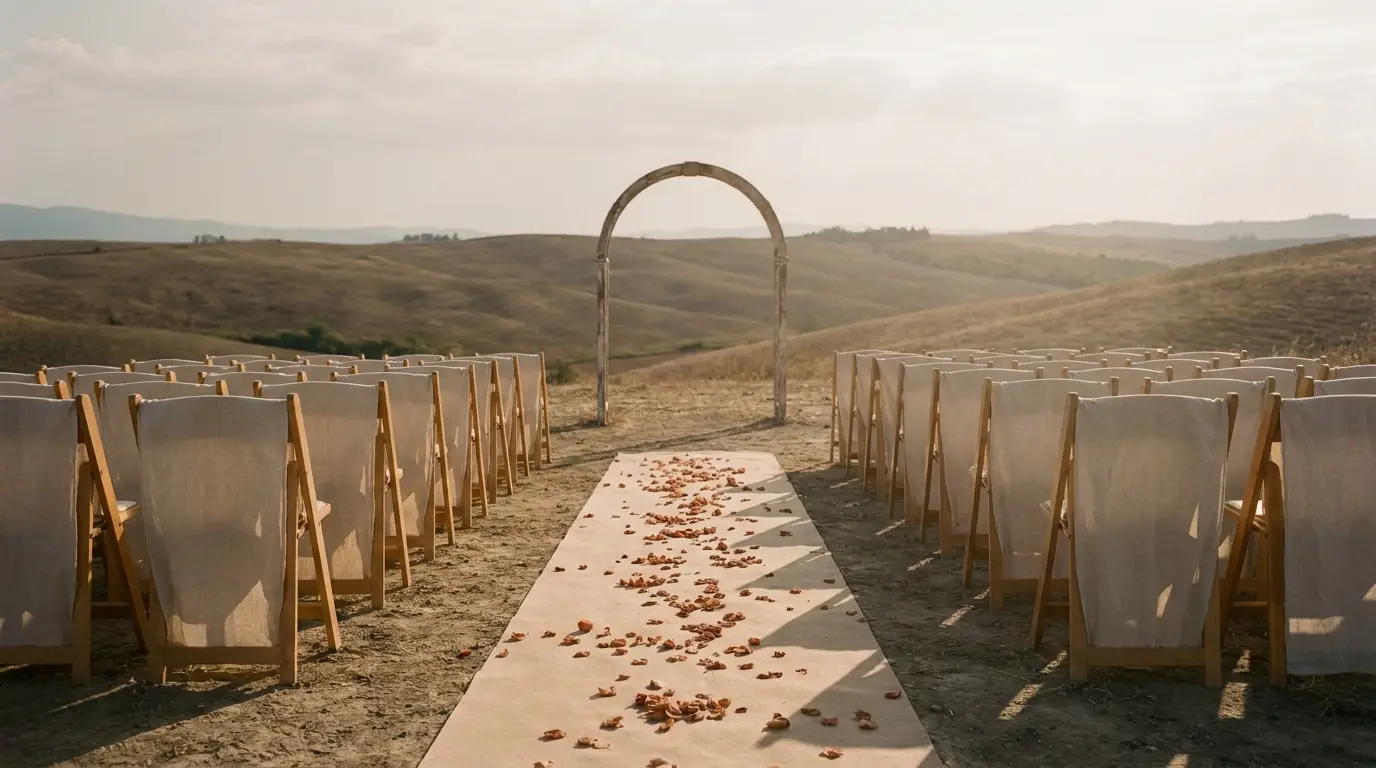
An outdoor ceremony is scheduled against the sun, not the clock. NOAA's solar calculator returns sunset for any location and date, and that one number sets the ceremony. With no first look, start about 3 hours before sunset so the ceremony, the family groupings and the couple portraits all land in full light. With a first look, 2 to 2.5 hours before sunset works, because only a short golden-hour session remains.
The margin after sunset is thinner than it looks. The U.S. Naval Observatory defines civil twilight as ending once the sun sits 6 degrees below the horizon, and past that point outdoor photography needs artificial light. Twilight is a grace period measured in minutes, not a second golden hour.
The seasonal swing is the part couples miss. The same 4:30 start that floats in June daylight can land after sunset in December across the northern half of the country, so the sunset lookup belongs in month 2 of the months-out schedule, while this document is being drafted and the ceremony time can still move.
Buffer rules
Build buffers into the day, not onto the end of it. Ten to 15 minutes after each major block absorbs a slip where it happens; one 45-minute cushion at 9:00 pm rescues nothing that went wrong at noon.
- Hair and makeup gets the largest buffer plus the early start; it is the first block of the day and the most common source of the first slip.
- Guests need 10 to 15 minutes to move between any two spaces, even inside one venue.
- Any drive between locations goes in at drive time plus 15 minutes, per direction.
- The photographer's coverage hours are a budget: 30 extra minutes spent on portraits at noon is 30 minutes off the dance floor at night.
- Feed the couple. A scheduled 15 minutes to sit and eat is the one block nobody else will notice and you will.
Then build the last hour backward from the venue's hard end. A 10:00 pm curfew with a 15-minute send-off puts the last dance at 9:45 and the cake no later than 8:45, and the breakdown clock starts the moment guests clear. Curfews are contract terms rather than suggestions, and the same contract usually prices what happens if you run past one.
None of this self-executes. A timeline holds because one person who is not getting married owns it on the day, cueing vendors and deciding which buffers get spent. Nashville coordinators run exactly this document as the core of a month-of package, which is what makes the day executable by someone who was not there for the year of decisions behind it.
Key takeaways
- Build from the ceremony time in both directions; outdoor ceremonies build from sunset instead.
- Use honest durations: 45 to 60 minutes per person in the chair, family formals from a named list at 3 minutes a grouping.
- A first look moves about an hour of portraits before the ceremony and buys you your own cocktail hour.
- No first look: stretch cocktail hour to 75 or 90 minutes and start the ceremony about 3 hours before sunset.
- Buffer 10 to 15 minutes after every block, and build the final hour backward from the venue curfew.
- Name one person who is not getting married to own the document on the day.
Frequently asked questions
What time should a wedding ceremony start?
Indoors, 4:00 to 5:00 pm is the standard start because it leaves a full morning for preparation and lands dinner at dinnertime. Outdoors, the sun decides: about 3 hours before sunset with no first look, 2 to 2.5 with one. Look up your date's sunset before you print anything.
How long is a full wedding day?
For the couple, 12 to 14 hours from the first makeup chair to the send-off; the sample above runs 14. Guests experience about 6 of them, from ceremony to last dance. The gap between those two numbers is the morning, which is exactly where timelines most need honest durations.
What time should hair and makeup start?
Count backward: 45 to 60 minutes per person through the available chairs, plus 30 to 45 minutes for dressing, plus a buffer, ending an hour before the first look or the ceremony walk. Four people and one artist means an 8:00 am start for a 4:30 ceremony. More chairs buy later mornings.
How long should a wedding ceremony be?
A civil or secular ceremony runs 20 to 30 minutes, and guests do not experience that as short. A full religious liturgy runs 45 to 75 minutes or more, depending on the tradition. The number matters mostly for what follows it: every downstream block starts when the recessional ends.
How long is cocktail hour?
Sixty minutes when portraits are done before the ceremony. Without a first look, stretch it to 75 or 90 minutes, because the couple, wedding party and family photos all have to fit inside it. Longer than 90 and guests notice; shorter than 60 and the room flip or the photographer loses.
Should we do a first look?
Do one if you want portraits in controlled light and a cocktail hour you actually attend; skip it if the aisle reveal matters more to you than either. It is a preference, not a rule. The only mistake is skipping it and keeping a 60-minute cocktail hour anyway, which breaks the afternoon.
How much buffer time should a wedding timeline have?
Ten to 15 minutes after every major block, placed where the slip happens rather than pooled at the end of the night. Give the largest buffer to hair and makeup, add 10 to 15 minutes for any guest movement between spaces, and pad every drive by 15 minutes per direction.
What order do wedding reception events go in?
The common order is grand entrance, first dance, welcome toast, dinner, toasts, parent dances, open dancing, cake, last dance, send-off. Putting the first dance straight off the entrance works because everyone is already watching. The order can move; what cannot move is the venue's end time.
What time do weddings usually end?
Ten to 11:00 pm at most venues, and the end time is usually the venue's decision rather than yours, written into the contract as a curfew. Build the last hour backward from it: send-off, last dance, cake, in that order. Overtime, where offered at all, is priced in the same contract.
Who keeps the wedding day on schedule?
One named person who is not getting married: a month-of coordinator, a planner, or a genuinely deputized friend with the document and every vendor's number. The venue's included coordinator manages the building and its staff, not your vendors, so the timeline still needs an owner of its own.
When should the wedding day timeline be finalized?
Draft it 2 to 3 months out, while vendors can still adjust arrival windows, then finalize after the RSVP deadline sets the true headcount. Every vendor and the wedding party should hold the final version at least a week before the day, with the same times on every copy.