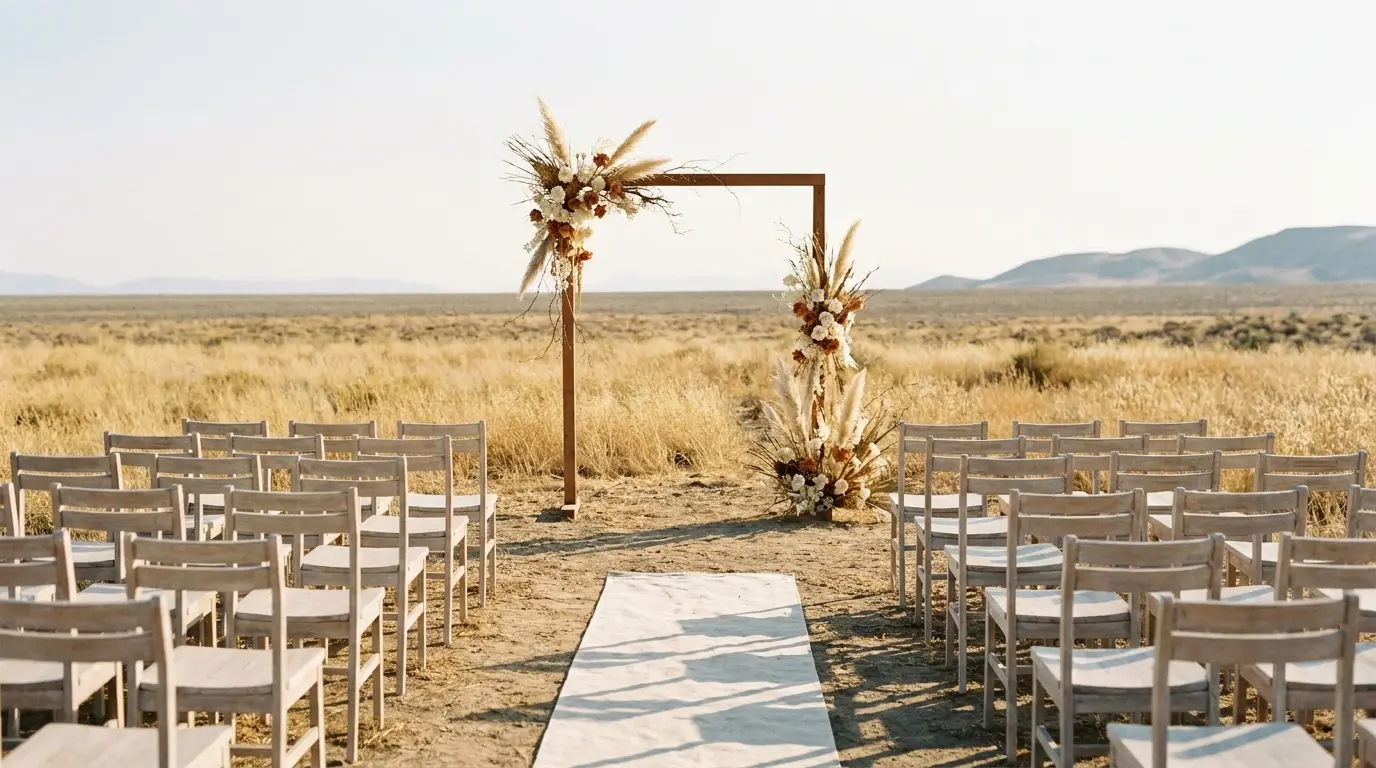
A wedding ceremony runs 20 to 30 minutes, and it is the only part of the day guests watch in complete silence. Get the wedding ceremony order wrong and it shows immediately: an aisle nobody cued, a reader who did not know when to stand, an officiant asking for rings that are still in a jacket in the parking lot. The standard sequence below fixes all of it, segment by segment, with the minutes each one takes.
The standard order, start to finish
The sequence below is the American default: what a Protestant, nondenominational or secular ceremony follows unless the couple changes it. Every segment is movable and several are optional, but the skeleton is stable enough that officiants, musicians and photographers plan around it without being told.
- Prelude. Music starts 20 to 30 minutes before the ceremony while guests arrive and are seated. Ushers hold late arrivals at the back until a natural break.
- Family seating. Grandparents are seated, then the couple's parents. Traditionally the mother of the bride sits last, and her seating is the signal that the ceremony is starting.
- Processional. The officiant takes position, the wedding party enters, and the couple enters last. The change in music is the cue guests stand on.
- Welcome. The officiant opens with two to three minutes of welcome and framing. Housekeeping lives here too: unplugged-ceremony requests, a note about the sun.
- Readings. One or two guests read a passage chosen for how it sounds aloud. Each runs one to three minutes, and each reader learned their cue at the rehearsal, not at the microphone.
- Address. The officiant speaks about the couple for three to five minutes. In a religious ceremony this is the homily; in a secular one it is usually the couple's story, told by the person they chose to tell it.
- Vows and rings. The declaration of intent, the vows and the ring exchange take eight to ten minutes together, and vows you write yourselves add a minute or two each over the traditional repeat-after-me exchange.
- Pronouncement and kiss. The officiant declares you married, you kiss, and the room hears your names as a married couple for the first time. Under two minutes, and the photographer knew the wording cue in advance.
- Recessional. The couple exits first, to the loudest music of the ceremony. The wedding party follows in reverse processional order, then parents and grandparents, then guests row by row from the front.
Where the 20 to 30 minutes go
Segment lengths are predictable enough to plan against. The table shows typical ranges; the total lands between 20 and 30 minutes for most ceremonies, and the segments that stretch are the ones with speaking in them.
| Segment | Typical length |
|---|---|
| Prelude | 20–30 min before start |
| Family seating and processional | 3–5 min |
| Welcome and opening words | 2–3 min |
| Readings (one or two) | 2–6 min |
| Officiant's address | 3–5 min |
| Declaration of intent and vows | 3–6 min |
| Ring exchange | 2–3 min |
| Pronouncement and kiss | 1–2 min |
| Recessional | 2–4 min |
Two decisions determine whether you land at 20 minutes or 30. Readings are the first: each added reader costs one to three minutes plus a walk to the microphone. Personal vows are the second: a traditional exchange takes under two minutes total, while two self-written speeches at a minute each, plus nerves, can triple it.
The 20 to 30 minute figure is for a standalone ceremony. A wedding inside a full Catholic Mass runs closer to an hour, and traditions that add their own rituals build their own clock. Either way, the ceremony is one fixed block inside the day's hour-by-hour timeline, and everything downstream moves if it starts late.
Processional order by tradition
The processional is the one segment with real conventions attached, and the conventions differ by tradition. The three versions below cover most American weddings. Adjust freely: guests watch the aisle, not the rulebook.
Christian and secular default
- The officiant takes position first, often with the groom and best man entering from the side rather than walking the aisle.
- Grandparents and parents are seated, mother of the bride last.
- Groomsmen and bridesmaids enter, singly or in pairs, with the best man and maid of honor entering closest to the couple.
- The ring bearer and flower girl walk immediately before the final entrance.
- The bride enters last, traditionally escorted by her father, and stands on the left as guests face the couple. Her family and guests sit on the left; the groom's sit on the right.
Jewish processional
A Jewish processional carries more of the family down the aisle. The rabbi or cantor enters first, then grandparents, then the groom escorted by both of his parents, the wedding party, and finally the bride escorted by both of hers. Sides flip relative to a Christian ceremony: the bride stands on the right, and the ceremony happens under a chuppah, sometimes carried in and held by honored guests.
Modern adjustments that work
- Both partners walk, each escorted by their own parents, one after the other. Standard at Jewish weddings, increasingly common everywhere.
- The couple enters together. It solves the who-waits-up-front question and suits couples who already did a first look.
- No wedding party processional at all. The party sits in the front row, and the couple's entrance becomes the entire aisle moment.
- Any escort you want. The walk is an honor, not a legal role, and a mother, a grandparent, both parents or nobody all work.
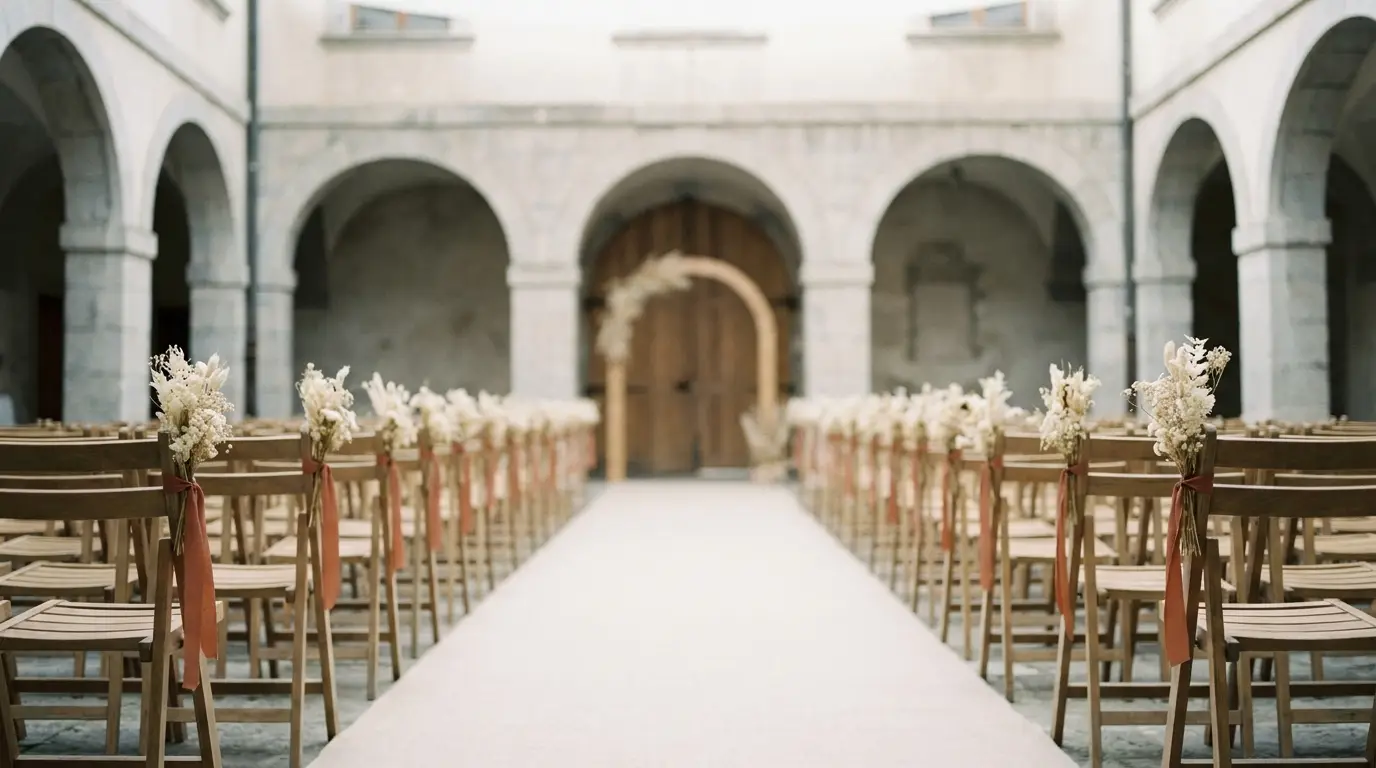
How long the walk takes is a property of the room, not the list. A courtyard aisle and a ballroom aisle make different demands of the same processional, which is why ceremony spaces on Austin venue listings state capacity and layout up front, and why the processional gets rehearsed in the actual space, usually the day before.
Traditional or secular: what actually changes
Less than the labels suggest. A secular ceremony keeps the same skeleton and rewrites the words; a religious one wraps fixed liturgy around the same core. The real difference is who controls the order: a house of worship hands you its form, while a secular officiant builds the order with you from a blank page.
- Catholic ceremonies add the Liturgy of the Word, with readings chosen from an approved list rather than an open one, and communion when the wedding sits inside a Mass.
- Jewish ceremonies add the ketubah signing before the processional, the seven blessings during the ceremony, and the breaking of the glass as the recessional cue.
- Secular ceremonies make readings, unity rituals and even the kiss optional. The fixed points are the declaration of intent and the pronouncement, and everything between them is up for negotiation.
Unity rituals, the candle, the sand pour, handfasting, a bottle sealed for a future anniversary, slot in after the rings and before the pronouncement. They add two to five minutes and give the middle of the ceremony its only visual variety, which is why photographers like them and windy outdoor ceremonies do not. Treat them as optional equipment: one at most, rehearsed once, dropped without regret if the day is running long.
Whatever the tradition, every transition in the order is a music cue: prelude, party entrance, final entrance, recessional. Four or five ceremony cues is a short list next to the music the reception will need, but it is the list with zero tolerance for a missed one.
The legal minimum inside the ceremony
Strip away every convention and the law asks for very little. New York's Domestic Relations Law requires no particular form or ceremony: the couple must declare, before an authorized officiant and at least one witness, that they take each other as spouses. Minnesota's solemnization statute asks for the same declaration and two witnesses. Everything else in the order is choreography.
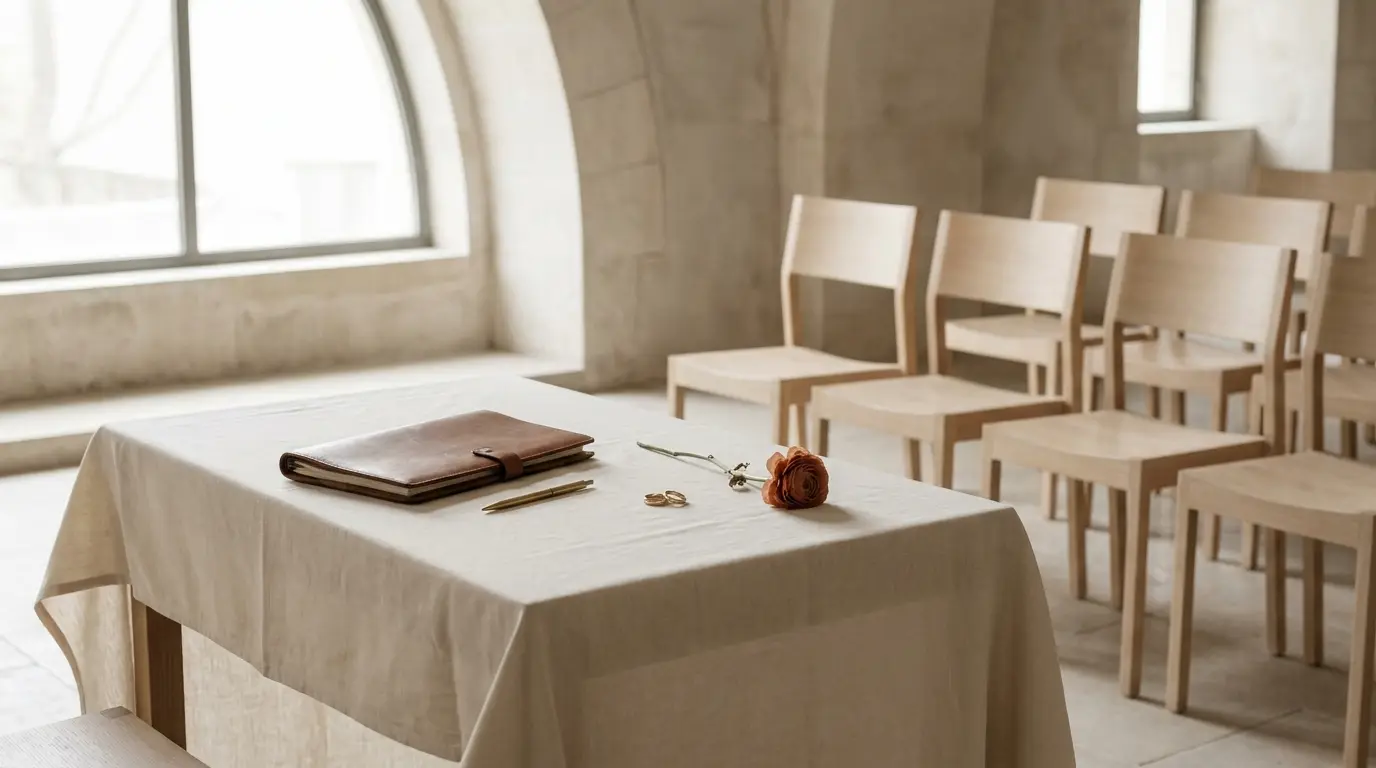
The paperwork brackets the ceremony rather than sitting inside it. The marriage license is applied for weeks before the aisle and signed minutes after the recessional, while the officiant and witnesses are still in the building. The declaration of intent, the I-do exchange, is the moment the ceremony satisfies the statute; the signatures are the moment the state can record it.
The processional, the readings, the unity candle and the kiss are all optional. The declaration, the officiant, the witnesses and the license are not.
The person holding all of it together is the officiant. They run the order in real time, cue the readers, hold the pace when nerves rush it, and in most states carry the legal duty to return the signed license. Choosing an officiant is choosing who runs the room for its most watched half hour.
After the recessional
The ceremony ends when the last row empties, but the order keeps running for a few minutes. The couple and witnesses sign the license, family photos happen while everyone is still gathered and dressed, and guests drift toward drinks.
From there the day changes hands. Cocktail hour absorbs the gap while the room flips, and the reception runs on its own timeline of entrances, toasts and dances. The ceremony order got you married; the reception order keeps a room of guests fed and moving for the rest of the night.
Key takeaways
- The standard order is nine segments: prelude, family seating, processional, welcome, readings, address, vows and rings, pronouncement, recessional.
- Budget 20 to 30 minutes. Readings and self-written vows are the two segments that stretch it.
- Rehearse the processional and recessional only. The middle runs itself when the officiant is competent.
- Start from your tradition's processional, then adjust freely: both-parent escorts, entering together, or no party processional at all.
- Only the declaration, officiant, witnesses and license are legally load-bearing. Cut anything else you do not want.
Frequently asked questions
What is the correct order of a wedding ceremony?
The standard American order is prelude, family seating, processional, officiant's welcome, readings, address, declaration of intent and vows, ring exchange, pronouncement and kiss, then recessional. Religious ceremonies add fixed liturgy around that core. Every segment except the declaration and pronouncement is optional or movable.
How long is the average wedding ceremony?
Most secular and Protestant ceremonies run 20 to 30 minutes. A wedding inside a full Catholic Mass runs closer to an hour, and multi-ritual traditions set their own clock. The variable segments are readings, which add one to three minutes each, and personal vows, which can triple the vow exchange.
Who walks down the aisle first in a wedding?
In the default order, the officiant takes position first, often entering from the side with the groom and best man. Grandparents and parents are seated next, then the wedding party walks, then the ring bearer and flower girl, and the bride or final partner enters last. Jewish processionals start with the rabbi or cantor, followed by grandparents.
Which side does the bride stand on?
On the left, as guests face the couple, in Christian and most secular ceremonies, with her guests seated on the left. Jewish ceremonies reverse it: the bride stands on the right. Neither convention is law, and couples with no aisle-side tradition increasingly let guests sit wherever there is a chair.
What order does the recessional go in?
Reverse processional order, couple first. The newlyweds exit, then the maid of honor and best man, the rest of the wedding party in pairs, the flower girl and ring bearer if they lasted, then parents and grandparents. Guests leave last, row by row from the front, released by the ushers or the officiant.
What is the declaration of intent?
It is the I-do exchange: the officiant asks each of you whether you take the other as your spouse, and you answer in front of witnesses. Legally it is the heart of the ceremony, because state statutes typically require exactly that declaration and almost nothing else. The vows that follow are personal, not statutory.
Do you need witnesses at a wedding ceremony?
Usually one or two, set by state law. New York requires at least one witness besides the officiant; Minnesota requires two; a few states require none at all. Witnesses sign the marriage license after the ceremony, which is why the signing happens immediately, while everyone is still in the building.
When do you sign the marriage license?
Almost always in the minutes right after the recessional, at a side table with the officiant and witnesses. Signing before the ceremony is legal in some states but rare in practice. The officiant then returns the license to the issuing office, which records the marriage and produces the certificate.
Can we change the traditional wedding ceremony order?
Yes, and most couples change something: the escort, the readings, the unity ritual, the party processional. The two fixed points are the declaration of intent and the pronouncement, because those carry the legal weight. Keep the recessional last and loud, and everything between the welcome and the pronouncement is yours to arrange.
How long should processional music be?
Plan on two pieces: one for family and wedding party, one for the final entrance. Time the walk in the actual space at the rehearsal; most aisles take under a minute per group, so a full song is longer than you need. Pick music that survives being faded out early rather than a track with one late payoff.
Do the rings come before or after the vows?
After, in the standard order: declaration of intent, vows, then rings, so the rings seal what was just promised. Some officiants fold ring words into the vows themselves, which is fine legally, since neither element is what the statutes require. Whichever order you choose, tell whoever carries the rings, because the handoff is their only cue.