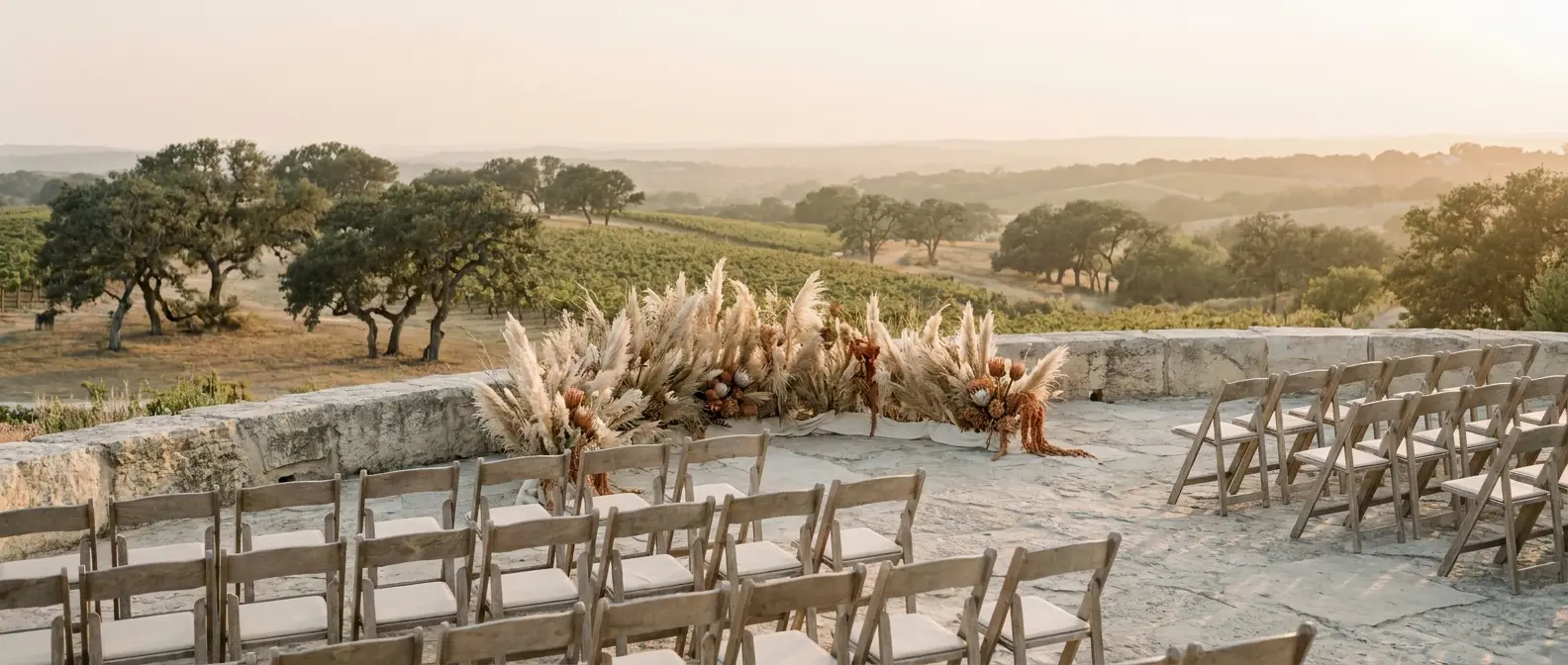
A two-market city: downtown lofts and hotels on one side, Hill Country ranches and vineyards forty minutes west on the other. Most planners here work both, and the logistics of the second are what separate them.
Listings
10
Starts from
$2,700
Full-service from
$8,000
Also covers
Dripping Springs, Wimberley, Fredericksburg
What drives the cost in Austin
The forty minutes between downtown and the Hill Country is the single largest cost variable in this market. A ranch venue looks cheaper than a downtown hotel until you add the shuttle contract, the generator, the tent on standby and the fact that every vendor bills travel to get out there. Planners who work both sides quote that gap up front; planners who only work downtown tend to discover it in month nine.
10 of 10 planners
Ranked number 101
Altar Ego Weddings
Best overall
Publishes the whole rate card, including the budget floor
Austin$$$
Starts at
$3,250Month-of
Full-service from
$8,000
Min. wedding budget
$50,000
Sells
Full-service · Partial · Month-of
Track record
Since 2007
Availability
Booking 12–18 months out
Publishes every fee on the site: full planning from $8,000, month-of coordination from $3,250
States a $50,000 minimum total wedding budget, so you know before the first call whether you are the right fit
Certified Wedding Planner, working Austin, Dripping Springs and the wider Hill Country since 2007
Rehearsal dinners and welcome parties are sold as a costed weekend add-on from $9,000 rather than absorbed
Coordination clients get unlimited email access from the day they book, not from the handover date
Names the three packages plainly on the pricing page instead of routing every enquiry through a form
No planners match all of those filters. Try removing one.
Venues in Austin
Book the venue first in almost every case; it sets the date, the guest cap and most of the constraints a planner then works within, and good planners are booked around venue availability rather than the reverse.
Full-service, partial and month-of are three different products at three different orders of magnitude. Two quotes are only comparable once you know they cover the same scope.
02
Read the venue, not just the planner
A blank-box warehouse costs a planner roughly three times the hours a hotel does. If your venue is a raw space, weight experience with raw spaces above everything else on the listing.
03
Ask when the handover starts
True day-of coordination does not exist. What is sold under that name is month-of: six weeks is good, four is workable, and "the rehearsal" is not an answer.
04
Treat credentials as facts, not ranks
A credential tells you what someone studied and which association admitted them. Read it alongside years active and weddings delivered rather than on its own.
Common questions
How much does a wedding planner cost in Austin?
Published fees in Austin start at $2,700 with Kindly Kindled Events, and 3 of the 10 planners listed here publish a price at all. Full-service planning in this market runs from $8,000 to $8,000 where firms state it. The tier decides the order of magnitude far more than the individual planner does, so establish whether you are buying full planning, partial planning or month-of coordination before you compare two numbers.
How far in advance should you book a wedding planner in Austin?
Twelve to eighteen months out for full-service planning in Austin, and earlier if your date falls on a peak Saturday. Month-of coordination books far later, commonly three to six months out, and several planners here take work inside 90 days. The top-ranked listing on this page is currently booking 12–18 months out. The constraint is rarely the planner's diary on its own; it is that the good ones are booked around venue availability, so the venue usually has to come first.
Do you need a wedding planner in Austin if the venue has a coordinator?
They do different jobs, and the venue coordinator works for the venue. Their responsibility is that the building delivers what the building sold you: the room is set, the staff show up, the bar runs. A planner works for you and manages every vendor you hired, including the ones the venue has never met. The question that settles it is simple: who confirms my florist, band and photographer two weeks out, and is that written into the venue contract? It usually is not.
What is the difference between full-service planning and month-of coordination?
Full-service planning starts at the beginning and covers sourcing, design, budget and the day itself, typically over twelve to eighteen months. Month-of coordination starts four to six weeks out, takes a wedding you have already planned, confirms every vendor and runs the day. 9 of the 10 planners in Austin sell month-of coordination. True day-of coordination does not really exist: nobody can absorb a year of decisions in eight hours, and what is sold under that name is almost always month-of.
What does the average wedding cost in Austin?
Nationally the mean sits around $33,000 – $35,000 with a median of $20,000 – $25,000, and the median is the more useful number because a handful of very large weddings drag the mean upward. Austin sits above the national figure. The forty minutes between downtown and the Hill Country is the single largest cost variable in this market.
Which Austin wedding planners publish their prices?
Altar Ego Weddings, Something To Celebrate and Kindly Kindled Events publish a starting fee on their own website. That is 3 of 10 listings on this page. Published pricing is not a quality signal on its own, but it does tell you which firms are comfortable being compared, and it saves you a discovery call to find out you are out of range.
Do Austin wedding planners cover Dripping Springs and Wimberley?
Yes. Austin planners work the whole metro, which here includes Dripping Springs, Wimberley, Fredericksburg and Georgetown. This site is organised by metro rather than by town for that reason: nobody picks a wedding planner by driving distance, and a page for every satellite town would list the same businesses over and over. If your venue sits outside the metro entirely, ask specifically about vendor travel charges, because that is where a nearby-looking venue quietly gets expensive.
What should you ask a Austin wedding planner on the first call?
Four things, in this order: what is the flat fee, when does your involvement actually start, how many weddings do you take in a year, and who will be on site on the day. The last one matters most and is asked least, because at several firms the person selling is not the person running your wedding. Track record is worth asking about too: Âme Soeur Events states 250 or more weddings delivered.
Is a percentage-of-budget fee normal in Austin?
It is common at the top of the market and worth converting before you agree to it. At 12% to 15% of total spend, a $60,000 wedding carries a $7,200 to $9,000 planning fee for work that has not necessarily changed from a $40,000 wedding, and it ties the planner's income to every upsell they recommend. Several Austin firms instead publish a minimum total wedding budget, from $50,000 upward, which tells you whether you are a fit before anyone quotes.
When is the cheapest time to get married in Austin?
Off-peak and off-Saturday, and the saving is larger than most couples expect. Moving a wedding from a peak Saturday to a Friday or a Sunday, or out of the busy season entirely, cuts venue fees first and vendor rates second. Planning fees move less: published starting fees across Austin range from $2,700 to $3,250, and that spread reflects scope rather than season. A planner who has worked the market a long time, like Bird Dog Wedding since 2002, will know which venues discount quietly and which never do.
Cookies
We would like to use analytics cookies to understand which pages people find useful. We will not set them unless you agree. See ourcookie policy.