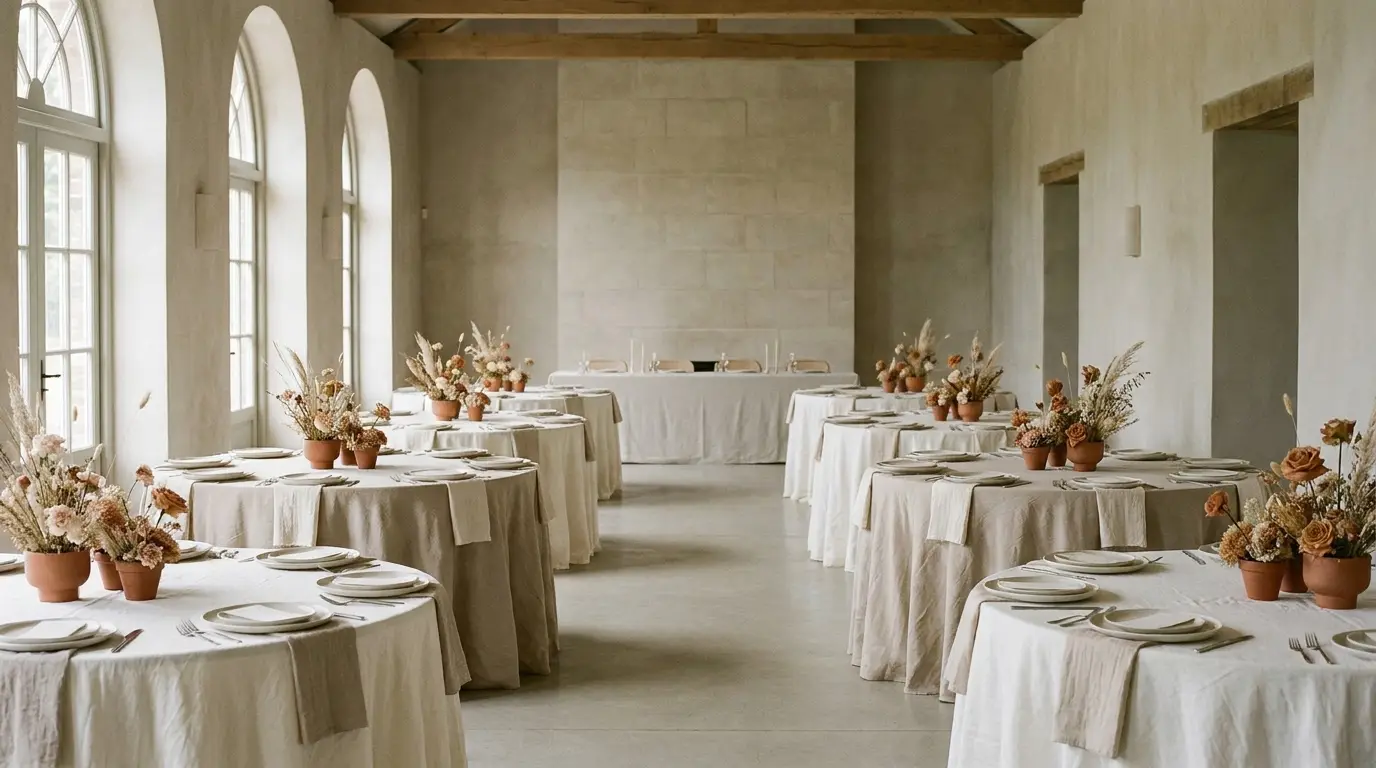
Wedding seating chart etiquette has a reputation as a minefield: divorced parents, the singles table, a kids table nobody asked for, a head table that ranks your friends in public. Get one call wrong and a guest feels it for four hours. The good news is that almost every hard case has a settled convention, and the whole exercise runs on two dates you can put in a calendar today.
Assigned tables, assigned seats, or neither
Above about 50 guests, assign tables. Open seating at 120 produces one outcome every time: the people who arrived first sit with everyone they know, and the people who arrived last sit with nobody they know. Below 50, one long table or a few reserved family tables sort themselves.
Whether you also assign chairs is a catering question, not a taste question. A plated dinner with a choice of entrée needs a place card at each seat with a meal marker, because a server carrying two beef and six chicken has to know which chair ordered what. Buffets, stations and family-style service need assigned tables and nothing more.
The chart itself is downstream work. Every difficult pairing in the room was created months earlier, when the guest list was built; the chart just prints those decisions where everyone can read them.
The head table has three standard shapes
| Head table option | Built for |
|---|---|
| Full wedding party | Big rooms; parties whose partners know each other |
| Sweetheart table | Couples who want to eat, move, and rank nobody |
| Family head table | Smaller weddings; two families on easy terms |
The full-party table is the traditional long table facing the room, couple in the center. Its one real problem is partners: seat the wedding party alone and you have stranded six spouses at tables of strangers on a night their partner is unavailable. Modern practice either adds partners to the head table or scatters the party among the guest tables with their dates, and both are correct.
A sweetheart table seats the two of you and nobody else. You actually eat, you can leave to visit tables without abandoning anyone, and no friend is ranked above another. The cost is visual: in a large room it can read as sparse, which is fixed by putting the wedding party at the two nearest tables.
The family head table, with both sets of parents flanking the couple, is the oldest form and the most fragile. It assumes two intact families who enjoy each other. Where that is true, it is the warmest option in the room. Where it is not, use one of the other two shapes rather than an arrangement built on hope.
Divorced parents: two tables, equal distance
The convention is simple and it works. Each parent hosts their own table of family and close friends, both tables sit equally close to the couple, and step-parents sit with their spouses. Neither table is labeled anything other than a number.
Never seat divorced parents together on the theory that they will manage for one night. If they offer to share a table, and some do, take the offer. The distinction matters: sharing is theirs to volunteer, not yours to assign, and a forced parents' table fails at dinner, in front of the room.
This is also where the family head table quietly dies. Putting one parent beside you and the other at a numbered table is a ranking everyone can see. A sweetheart table or a wedding party table sidesteps the choice entirely, which is most of why they have become the default.
The singles table embarrasses everyone at it
Grouping guests by relationship status announces that status to the room, and it misreads the room anyway: three in ten U.S. adults are single by Pew Research Center's count. On a typical guest list that is a constituency, not a table.
Seat single guests with the friend group they came from, exactly as you would if they had brought a date. If there are two people you genuinely think should meet, put them at the same table inside a group of mutual friends. A table built as a pairing display is visible to its targets before the salad arrives.
Kids tables work for exactly one age band
Children under about five sit with their parents, in a high chair pulled to the table; the venue counts high chairs in the floor plan, so tell them the number early. A kids table starts working around age five and stops working around ten or eleven. In that band, put it near the parents' tables, cover it in things to do, and assign one adult or a hired sitter to it.
Past eleven, seat kids with their families as the adults they are trying to be. A fourteen-year-old placed at the crayon table registers it as a verdict. Teenagers do well seated together at a regular table, or folded into family tables, and never at a kids table.
Count children separately for the caterer. Most caterers price a kids meal well below the adult plate, and the final count they ask for will split adults, kids and vendor meals into their own lines.
Group the rest by shared context, never by leftovers
Build tables out of groups that already exist: the college friends, the work friends, the neighborhood, the cousins. When a group runs over one table, split it across two adjacent tables rather than exiling its two quietest members to strangers.
The failure mode is the leftovers table: eight people whose only shared trait is not fitting anywhere else, and who all know it. Distribute remainders instead, one or two per table, into tables where they know at least one person by more than name. That sentence is the entire test of a finished chart.
Feuds and exes get distance without theater: different tables, not opposite corners of the building. Most seating fights are guest-list fights that survived. The rules for who sits with whom were really settled when the invitations went out; the chart only enforces them politely.
Escort cards, place cards, or one big chart
| Piece | What it does |
|---|---|
| Seating chart board | One alphabetized list of names and table numbers |
| Escort card | One card per guest or couple, name and table number |
| Place card | At the chair; marks the exact seat and the meal choice |
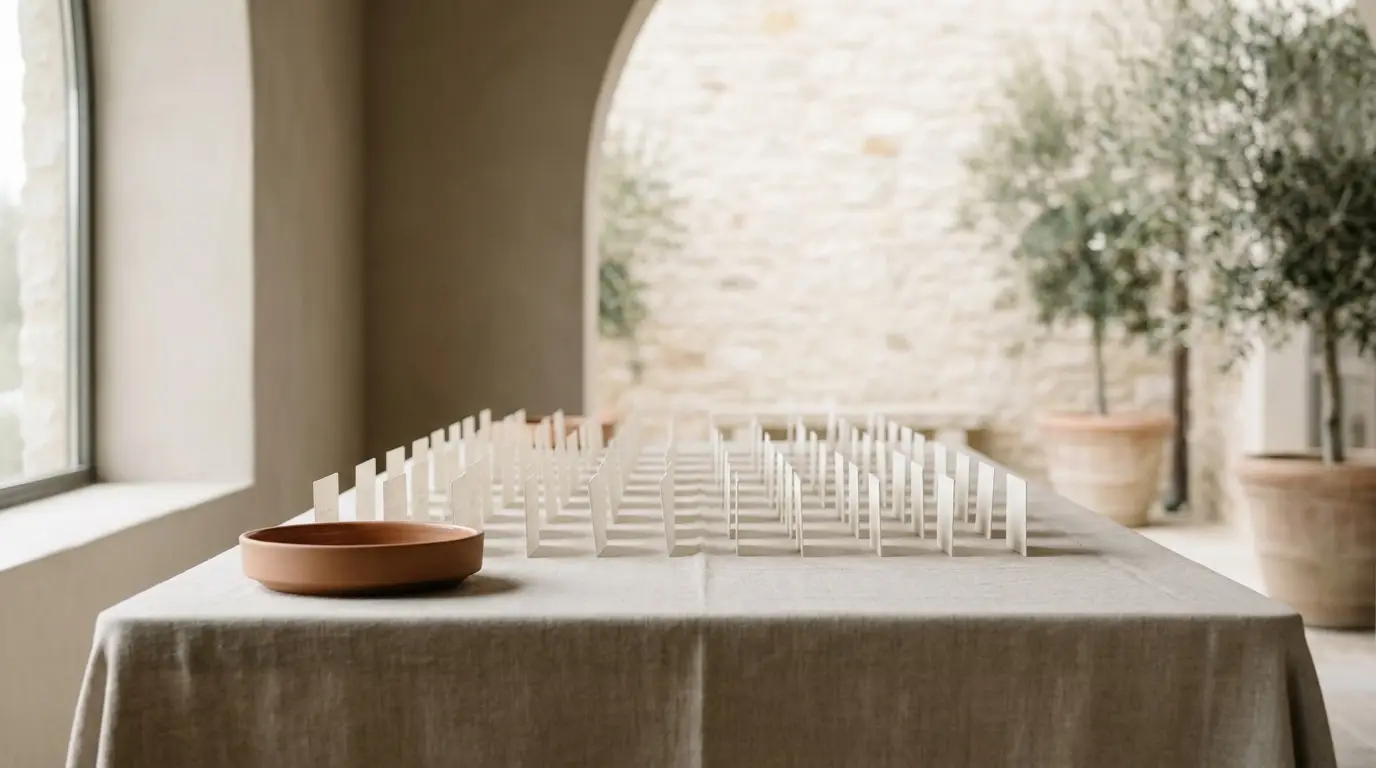
A single printed chart is the cheapest and fastest option and it is enough for any buffet wedding. Alphabetize it by last name, never by table: guests are looking for their own name, and a by-table layout makes 120 people read every list to find it.
Escort cards do the same job one card at a time and absorb late changes better, since reprinting one card beats reprinting a board. Place cards become mandatory only when the dinner is plated with an entrée choice; the meal marker on each card, a dot, an icon, a ribbon color, is for the servers, not the guests. Your catering manager will tell you which format their staff needs, and that answer overrides preference.
The room already did the math
A 60-inch round seats eight in comfort and ten in contact. An 8-foot banquet table seats eight along the sides, ten with the ends in play. The dance floor, the band and the buffet stations all subtract table positions from the floor plan, which is why a room's published capacity and its seated-dinner capacity are different numbers.
The gap is not marketing; it is fire code. Austin's building department, to take one written example, cuts a room's standing occupancy by six for every table added when it issues occupant load cards. The question to ask any venue is seated capacity with a dance floor, not capacity.
Layouts differ enough that the same 120 names make twelve tables in one room and fifteen in another, which changes every grouping decision above. Capacity and layout constraints are stated on our listings for Austin venues, because they are the first numbers a chart has to obey.
The chart locks on the caterer's date, not yours
Your catering contract names a final-count date, commonly 10 to 14 days before the wedding. Your RSVP deadline, typically 3 to 4 weeks out, exists to feed that date, and the week between the two is for chasing the people who did not reply. The chart locks inside that window and not earlier, because a chart built on projected RSVPs gets rebuilt.
Draft in groups early, around the time invitations mail: which clusters exist, which tables they roughly fill. Assign actual seats and print nothing until the count is final. Then expect two or three changes in wedding week anyway, and leave an open seat at a couple of tables near the back to absorb them without a redraw.
The order of operations matters at the other end too. Toasts, table visits and the first dance are choreographed around where people sit, so the chart is finished before the reception timeline is written, not after.
Key takeaways
- Assign tables for anything over about 50 guests; add place cards only for plated service with an entrée choice.
- Pick the head table shape the room and the families can support: full party, sweetheart, or family table.
- Divorced parents host separate tables at equal distance. Sharing is their offer to make, not your assignment.
- No singles table and no leftovers table: every guest knows at least one person at their table by more than name.
- RSVP deadline 3 to 4 weeks out, final count 10 to 14 days out, chart locked between the two, printed after.
Frequently asked questions
Do you need a seating chart at a wedding?
Above about 50 guests, yes, and many venues and caterers require one because service depends on it. Below 50, a single long table or a few reserved family tables work without assignments. The chart is for the guests' comfort as much as the staff's: nobody has to negotiate a seat in a room of strangers.
Do you assign specific seats or just tables?
Assign tables for most weddings. Specific chairs matter in two places: a plated dinner with an entrée choice, where servers need a place card with a meal marker, and the head table, which should always have assigned seats to avoid a public shuffle. Everywhere else, guests pick their own chair at their assigned table.
Who sits at the head table?
Traditionally the couple and the wedding party, with the couple centered and facing the room. Modern practice adds the party's partners to the table or moves the party to guest tables with their dates, since stranding partners among strangers is the arrangement's known failure. The alternatives are a sweetheart table for two or a family table with both sets of parents.
Where do divorced parents sit at a wedding reception?
Each hosts their own table of family and friends, and both tables sit at equal distance from the couple. Step-parents sit with their spouses. Divorced parents share a table only when they volunteer to, and a family head table should be dropped entirely rather than seating one parent beside you and demoting the other.
Is it OK to have a singles table at a wedding?
No. It groups guests by relationship status and announces that status to the room, and with roughly three in ten American adults single, it misreads how ordinary being single is. Seat single guests with their friend groups, exactly as if they had brought a date.
Where should kids sit at a wedding?
Under about five, with their parents. From five to ten or eleven, a supervised kids table near the parents' tables works well, stocked with things to do. Older kids and teenagers sit with their families or together at a regular table; a teenager assigned to the kids table reads it as a demotion.
When should you make your wedding seating chart?
Draft it in groups when the invitations mail, and finish it in the window between your RSVP deadline and the caterer's final-count date, usually 10 to 14 days before the wedding. Nothing prints until the count is final. Charts locked before the RSVPs close get rebuilt, usually twice.
What is the difference between escort cards and place cards?
An escort card, displayed alphabetically at the entrance, tells a guest which table is theirs. A place card sits at the table and marks the exact chair, usually carrying a meal indicator for the servers. Buffet weddings can skip place cards entirely; plated dinners with an entrée choice cannot.
How many guests sit at each wedding table?
Eight fit comfortably at a standard 60-inch round, ten at a squeeze. An 8-foot banquet table seats eight along the sides or ten using the ends. Fill to eight and hold the extra chairs; a table of ten with two empty seats looks worse than a table of eight full.
Do wedding vendors get seats at the reception?
Working vendors with meals in their contracts, usually the photographer, videographer, band or DJ, and planner, eat during dinner service but do not appear on the seating chart. Give them a vendor table or a staffed spot near the service area, and count their meals in the caterer's final number on the vendor line.
Should the seating chart be alphabetical or by table?
Alphabetical by last name, always. A guest is looking for one name, theirs, and an alphabetized list finds it in seconds. Charts organized by table number force every guest to scan every table's list, which is how the line at the entrance forms.